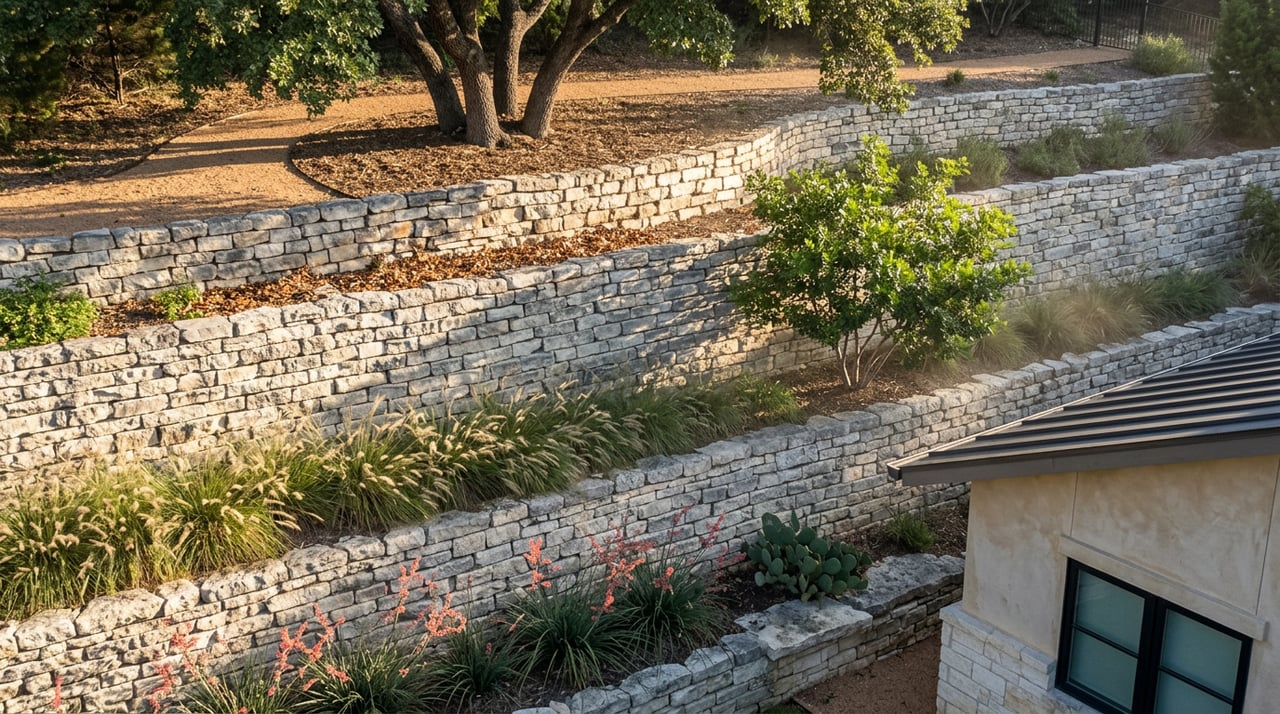
Stand on most lots along the ridge and the ground drops away in front of you before it ever levels off again, a run of Hill Country hills stacked one behind the other until they fade into haze. That drop is the entire sales pitch. It can also affect site-preparation costs, so your builder's per-square-foot number on paper may not match the number on the final invoice.
Copper Ridge was built east to west along a dominant ridgeline, and homes are terraced down the slope so that nearly every lot gets an unobstructed view of the hills and meadows below. That terracing did not happen by accident, and it does not happen for free. The same grade change that makes the view worth paying for is what a foundation crew has to engineer around before anyone pours a slab.
Most builder quotes you'll see for a Hill Country custom home assume a flat, cleared lot with standard soil and utilities already at the road. Ridge lots rarely meet that description. Shallow limestone bedrock is common enough in Comal County that it often forces builders into drilled pier foundations instead of traditional slabs, and once a foundation crew hits that rock layer, excavation costs climb fast. Cost guides published in 2026 put rock excavation and site milling on Hill Country lots anywhere from roughly $15,000 to $60,000, depending on how much limestone the site actually holds.
On a slope steep enough to make a slab impractical, the foundation itself changes. Builders working sloped Hill Country parcels frequently move to pier-and-beam or helical pier foundations instead of a conventional slab, because that approach accommodates grade change without the cost of heavy cut-and-fill grading. That switch typically adds $30 to $55 per square foot compared to a flat-site slab. On a 3,000-square-foot home, the added cost can reach six figures before a single wall goes up.
None of this shows up in the headline per-square-foot figure agents and builders quote casually in conversation. Cost guides published in 2025 and 2026 put full Hill Country custom construction anywhere from $200 to $450 per square foot depending on finish level and site complexity, and that range exists precisely because two lots quoted the same starting number can land tens of thousands of dollars apart once the ground gets involved.
Here is roughly how that gap breaks down, based on current Hill Country cost data:
| Cost category | Typical added range | Why it applies on a ridge lot |
|---|---|---|
| Rock excavation and site milling | $15,000 to $60,000 | Limestone and caliche sit close to the surface across Comal County |
| Foundation type premium | $30 to $55 per sq ft | Pier-and-beam replaces slab on steep grade |
| Geotechnical soil testing | $800 to $1,500 | Required before foundation design on unpredictable rock |
| Well and septic (if not on county service) | $15,000 to $40,000 | Many acreage lots outside city limits require private systems |
| Aerobic septic system, rocky soil | $18,000 to $35,000 | Standard gravity systems often fail perc tests on rock |
Not every Copper Ridge lot will carry every line on that table. A lot closer to the top of the ridge with shallower grade change may need far less foundation work than one on a steeper drop toward the back of the community. That is exactly the point. The lot price and the builder's opening quote tell you almost nothing about which end of that range you're on until a geotechnical report and a site walk with your builder confirm it.
If the slope were the only variable, a buyer could offset a higher site cost by building smaller. Copper Ridge's recorded architectural guidelines close that option. Single-story homes must run at least 2,400 square feet, and two-story homes at least 2,800 square feet. Exteriors are required to be stone or stucco, roofs must be standing-seam metal or clay tile, and fencing is limited to wrought iron, ranch-style pipe, or similarly approved decorative materials, with solid wood and chain-link excluded entirely. Setbacks typically run 50 feet from the front property line and 60 feet from the rear, with side setbacks of 15 to 25 feet depending on the lot.
Every plan goes through the community's Architectural Control Committee before construction begins, and the committee reviews everything from exterior materials to where the home sits on the lot. That review protects the look and resale value of the neighborhood, and it also means you cannot quietly shrink the footprint or swap in a cheaper roofline to absorb a higher site-prep bill. The square footage floor and the material list are fixed regardless of what the ground underneath costs to build on.
Landscaping gets the same treatment. The ACC encourages native, drought-tolerant plantings, and any major landscaping change needs approval, which is one more step that has to happen before a yard is finished and a certificate of occupancy feels final.
The math that actually matters on a ridge lot is simple to state and easy to miss: the slope sets your site cost, and the ACC sets your minimum house size. Neither one moves to make room for the other.
Buyers should account for Copper Ridge's construction-completion window when planning a build. Once building starts, Copper Ridge requires homeowners to complete their custom homes within a set window, generally around 12 months.
It becomes a real pressure point when a rock excavation problem, a failed perc test, or a delayed geotechnical report pushes the front end of a project back by weeks. Custom builds in the Hill Country already run 12 to 18 months in current market conditions once you account for permitting, design, and finish lead times that can stretch 12 to 20 weeks on specialty materials. A ridge lot that needs unplanned foundation redesign after the framing schedule is already set does not get more calendar room from the HOA because the ground turned out to be harder than expected.
This is the kind of detail that belongs in a conversation with your builder and your agent before you write an offer, not after your excavator finds out the hard way what is under the topsoil.
Picture two buyers, both handed the same builder's opening estimate of roughly $280 per square foot for a 3,200-square-foot home in Copper Ridge, both planning a similar stone-and-metal-roof design that satisfies the ACC without issue.
The first buyer's lot sits near the top of the ridge with a gentle, buildable grade. A standard geotechnical report comes back clean, a conventional foundation works with minor grading, and utilities run a short distance to the house pad. Their final number lands close to the original quote.
The second buyer's lot sits farther down the slope, where the drop that creates the better view also means more retained soil, a pier-and-beam foundation instead of a slab, and a longer utility run. Rock excavation, the foundation premium, and site engineering combine to add well over $100,000 to the same base quote, on the same floor plan, from the same builder.
Nothing in either buyer's contract with the builder was wrong. The gap came entirely from the lot, and it is the single biggest reason two homes advertised at a similar per-square-foot price in the same neighborhood can close at meaningfully different totals.
Does every lot in Copper Ridge require a pier-and-beam foundation? No. Grade varies significantly across the ridge, and lots with a gentler slope may work with a more conventional foundation. A site-specific geotechnical report is the only reliable way to know before you buy.
Do plans require ACC review, and what is the construction-completion window? Copper Ridge's recorded rules route all building plans through the ACC before construction can begin, and the community's guidelines call for a completion window of roughly 12 months once building starts. Buyers should build their construction schedule around that timeline from the start rather than treating it as a formality.
Can I build under the minimum square footage if my lot is smaller? The recorded minimums, generally 2,400 square feet for single-story and 2,800 square feet for two-story homes, apply regardless of lot size, so a smaller or steeper lot does not come with a smaller square footage requirement.
Is Copper Ridge on county water and sewer or private systems? This varies by section and should be confirmed for your specific lot before you write an offer. If a lot does require a private well or septic system, budget separately for that cost rather than assuming it is included in a builder's standard quote.
If you are looking at a lot in Copper Ridge and want a clear-eyed read on what that specific piece of ground will actually cost to build on, The Renfeld Group can walk the site with you, pull the current ACC guidelines, and help you line up a builder who has already worked this ridge before you sign anything.
This article is general information, not legal, tax or financial advice. Consult a qualified professional about your situation.

ADDRESS 453 W San Antonio St New Braunfels TX 78130
ADDRESS 453 W San Antonio St New Braunfels TX 78130