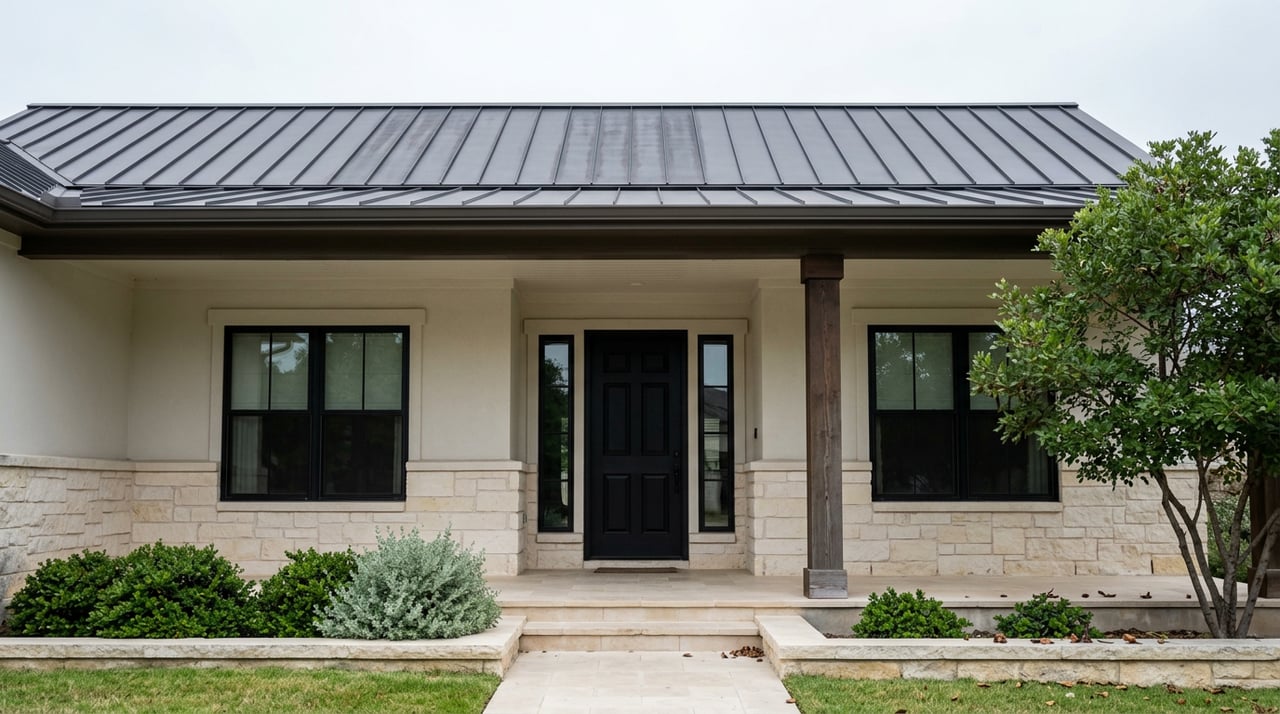
A friend of a client called us in July with a simple complaint. She'd toured Meyer Ranch, loved the pool at The Haus, put a hold on a lot with one of the community's builders, and left the sales office believing she'd found the rare Hill Country community with almost no ongoing dues. Six hundred dollars a year, billed quarterly at a hundred and fifty. Cheaper than her gym membership.
Then her lender ran the escrow numbers.
The mortgage payment she'd budgeted for jumped by more than two hundred dollars a month, and none of it came from the HOA. It came from a line she hadn't been shown at the sales center at all: the tax rate charged by the Meyer Ranch Municipal Utility District.
That gap is the story. Not because Meyer Ranch did anything wrong, and not because the HOA number is misleading on its own terms. It's because the HOA fee and the MUD tax rate are two halves of the same bill, and builders only hand you the half that makes the community look inexpensive.
Meyer Ranch's own FAQ page is straightforward about the number: HOA dues run $600 a year, split into four $150 installments, managed through KiTH Management Services. That fee funds the parts of community life you can see and use: the monthly resident events, the food truck nights and concerts at the Community Green, the upkeep on shared green spaces and trails.
What it does not fund is the infrastructure underneath all of it. The roads, water lines, sewer connections, and stormwater drainage that had to exist before a single home could be built came from somewhere else. In Meyer Ranch's case, that somewhere else is the Meyer Ranch Municipal Utility District, a political subdivision of the State of Texas created specifically to finance that kind of buildout with bonds and repay those bonds through property tax.
This is worth sitting with for a second, because it changes how you read the $600. A traditional HOA in a community without a MUD often has to charge more, because dues are the only mechanism funding long-term capital costs. A community that pushes those costs into a MUD tax instead can advertise a smaller HOA fee and still deliver the same amenities. The HOA number looks cheap because a different bill, on a different document, is doing heavier lifting.
According to Comal County's own 2025 tax rate schedule, the Meyer Ranch MUD carries a voter-approved rate of $0.95 per $100 of assessed value, split between a $0.15 maintenance and operations component and $0.80 dedicated to debt service. For comparison, New Braunfels' city tax rate sat at $0.4089 per $100 as of the 2024 tax year, according to figures from the Comal County Tax Office reported by Community Impact.
That's more than double.
To put real numbers on it: on a home assessed at $450,000, a $0.95 rate produces about $4,275 a year in MUD tax alone. The same assessed value taxed at New Braunfels' city rate of $0.4089 would produce roughly $1,840. The difference, close to $2,400 a year or about $200 a month, is the line item nobody hands you a brochure for. It sits on top of county tax, school district tax, and any other overlapping jurisdictions that apply whether or not a MUD is involved. It is not the whole tax bill. It's the part of the bill that exists specifically because Meyer Ranch is inside a district rather than inside the city.
It's also not unique to Meyer Ranch. The neighboring Kyndwood MUD carries the identical $0.95 rate in the same county tax schedule. As of reporting in April 2025, Comal County had approved at least seventeen MUDs and water improvement districts since 2020, twelve of them since 2023, largely because state law now lets developers finance infrastructure this way rather than waiting on city annexation. The rate isn't a red flag specific to one community. It's how a lot of new growth gets built out here.
| Meyer Ranch MUD | New Braunfels city | |
|---|---|---|
| Tax rate per $100 valuation | $0.95 | $0.4089 |
| Tax year | 2025 (adopted) | 2024 |
| Funds | Water, sewer, drainage debt and O&M | General city services |
The district's own disclosures give a sense of why this rate isn't likely to drop soon. Meyer Ranch MUD is authorized to issue up to $291.375 million in bonds. As of state debt filings tracked by the Texas Bond Review Board, the district had $34 million in tax-supported debt outstanding by fiscal year 2024, with $17.5 million of that issued in that year alone. That means the district has drawn on a small fraction of what it's authorized to borrow, and Meyer Ranch is still adding homesites and phases. More construction usually means more bonds. More bonds usually means the $0.80 debt-service portion of that rate has less reason to fall in the near term.
None of this means the tax rate will rise from here. It means the mechanics that produced $0.95 today, ongoing infrastructure debt tied to a district still building out, are the same mechanics likely to keep it near where it sits for a while.
The practical friction shows up less in the math and more in daily life. A Meyer Ranch MUD resident named David Beaudin described it plainly to Community Impact:
"When you move in, there's not really clarity. I lived in a city prior to this... and it was simple."
Beaudin's frustration wasn't about the tax rate itself. It was about not knowing whether to call the HOA, the MUD board, or the city when something needed fixing. That's a real feature of MUD life, not a Meyer Ranch-specific complaint. The HOA handles amenities and community programming. The MUD board, typically made up of residents elected in low-turnout district elections, handles water, sewer, and drainage. The city of New Braunfels handles neither, because the property sits outside city limits.
Not every New Braunfels master-planned community routes costs this way, which is part of why comparing communities by HOA fee alone falls apart quickly.
Vintage Oaks, a few miles down Highway 46, runs closer to the traditional model: HOA assessments around $700 a year in non-gated sections, with no comparable MUD tax layered on top, though gated sections there carry their own added assessments for gates and road maintenance.
Veramendi, closer to downtown New Braunfels, uses yet another structure. It sits in a Water Improvement District rather than a MUD, and its 2026 HOA assessments run $61 a month for the residential master assessment plus an additional $115 a month for a special common area assessment tied to one section of the community. Three communities, three different ways of financing the same basic need: paying for infrastructure and amenities somehow, whether through HOA dues, a WID tax, or a MUD tax.
That variety is exactly why the sticker-level comparison buyers tend to make, an HOA fee here versus an HOA fee there, doesn't tell you much on its own. You have to ask what each fee is and isn't paying for.
Meyer Ranch itself adds one more wrinkle worth knowing before you shop by price alone: the community includes homes from several builders on lot widths from 45 to 60 feet, with base prices that have ranged from the $360s to the $700s across recent phases. Two homes both listed as "Meyer Ranch" can differ by hundreds of thousands of dollars in base price before either buyer has looked at a single tax document. Our own neighborhood guide to Meyer Ranch walks through the builder lineup and lot sizing in more depth if that's the piece you're trying to sort out first.
If Meyer Ranch's amenities and location fit what you're looking for, none of this should scare you off. It should change what you ask for before you sign.
Does the MUD tax ever go away? Not on a fixed timeline. It typically declines only as bonds are retired and the debt-service portion of the rate shrinks, which depends on how much more the district borrows in the meantime.
Can I protest the MUD tax separately from my county appraisal? No. The MUD tax is based on the same assessed value the Comal Appraisal District sets for your property, so a successful protest of your appraised value lowers every tax line that uses it, MUD included.
Meyer Ranch remains one of the more amenity-rich, family-oriented communities between New Braunfels and Bulverde, and the low HOA fee is real. It's just one half of a two-part bill. If you're weighing Meyer Ranch against other Hill Country communities and want the full carrying-cost picture, not just the number the sales center leads with, The Renfeld Group can walk through the actual tax documents section by section and build you a comparison that holds up after closing. Request a Custom Market Plan and we'll bring the numbers the brochures leave out.

ADDRESS 453 W San Antonio St New Braunfels TX 78130
ADDRESS 453 W San Antonio St New Braunfels TX 78130